Srinivasa Ramanujan Aiyangar
22 December 1887 – 26 April 1920

Who Was He?
In a small town in southern India, far from the great libraries of Europe, a boy was born on December 22, 1887, in Erode, Tamil Nadu. His name: Srinivasa Ramanujan. He grew up in Kumbakonam, where his brilliance with numbers first began to shine — long before the world ever heard his name.
With no access to formal training in advanced mathematics, and armed only with a worn-out book (A Synopsis of Elementary Results in Pure and Applied Mathematics by G.S. Carr), Ramanujan began to develop new ideas in number theory, continued fractions, infinite series, and more.
By his late teens, he had already developed the infinite series for π, a formula more efficient than any known at the time. But he lived in poverty, working as a clerk in the Madras Port Trust in 1912, while scribbling formulas during office breaks on loose papers and in three now-famous notebooks.
The Self-Taught Genius
Ramanujan’s early discoveries included:
- Highly composite numbers (1915)
- Generalizations of the binomial theorem
- Deep studies into divisor functions and Euler's constants
- His famous formula for 1/π, which still stuns mathematicians for its beauty and convergence speed
All of these were developed without formal proofs — because he had never been taught how to write one. He believed the results came to him from Goddess Namagiri, as visions and dreams.
The 1913 Letter That Changed Everything
In January 1913, Ramanujan sent a handwritten letter to G.H. Hardy, a professor at Trinity College, Cambridge. The letter contained over 120 theorems — many of which Hardy had never seen before.
Hardy shared it with fellow mathematician J.E. Littlewood. They were stunned. Hardy later wrote:
I had never seen anything in the least like them before.
He immediately invited Ramanujan to England. After some hesitation due to religious concerns, Ramanujan sailed to England in March 1914.
Genius Meets the World
Ramanujan arrived at Cambridge in April 1914, just months before the outbreak of World War I. In spite of war, homesickness, a vegetarian diet in wartime England, and recurring illness, Ramanujan’s creativity exploded.
His major achievements during the Cambridge years (1914–1919) include:
- 1916: Earned a Bachelor of Science by Research (equivalent to a PhD) from Cambridge
- 1917: Elected a Fellow of the Cambridge Philosophical Society
- 1918: Elected a Fellow of the Royal Society (FRS) — one of the youngest ever, and only the second Indian at that time
- 1918: Became a Fellow of Trinity College, Cambridge — a rare honor
During these years, he co-authored five major papers with Hardy and published over 30 original papers in journals like Proceedings of the London Mathematical Society and Transactions of the Cambridge Philosophical Society.
Some of his most profound discoveries included:
- Partition formula: A precise asymptotic formula for the partition function , which counts the number of ways a number can be split into parts
- Mock Theta Functions: Mysterious and deeply elegant series that remained poorly understood until the 21st century
- Ramanujan-Hardy Number 1729: The famous “taxicab number”
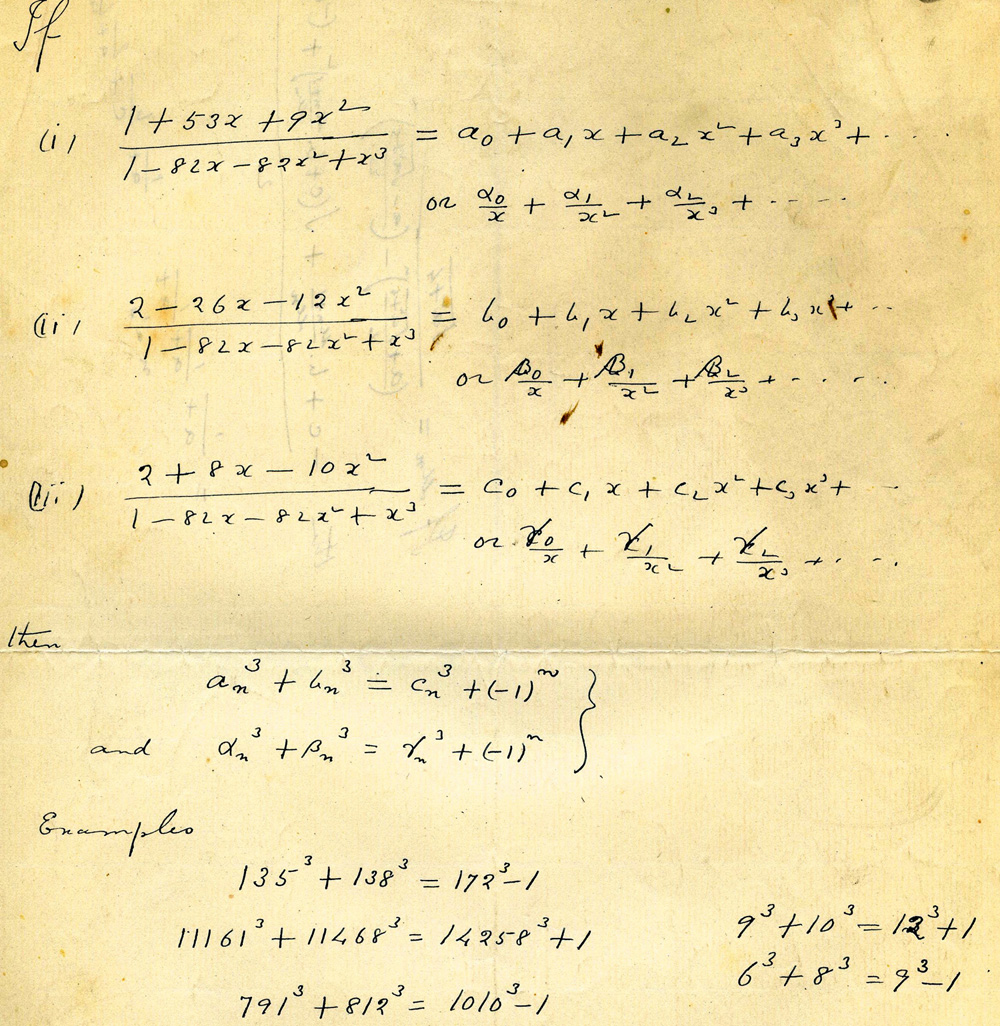
Hardy: “I came in a taxi numbered 1729 — it seemed dull.”
Ramanujan: “No, it is a very interesting number. It is the smallest number expressible as the sum of two cubes in two different ways.”
1729 = 1³ + 12³ = 9³ + 10³
Gone Too Soon, But Never Forgotten
After years of cold, malnutrition, and illness, Ramanujan returned to India in March 1919. He continued to work from his sickbed, producing more theorems and even sending letters to Hardy describing his Mock Theta Functions.
He passed away on April 26, 1920, at the age of just 32 — a devastating loss to the mathematical world.
But his work was far from over.
The “Lost Notebook” and Eternal Influence
In 1976, over half a century after his death, mathematician George Andrews discovered Ramanujan’s lost notebook in the archives of Trinity College. This 87-page manuscript contained results that had never been published — many of which are still being explored today.
Ramanujan's ideas now influence:
- String theory and quantum physics
- Black hole entropy (via modular forms)
- Computer science and cryptography
- Modern number theory
His legacy continues to grow, with scholars, physicists, and engineers still finding use in his formulas.
Why Ramanujan Matter
Ramanujan is not just a name in history. He is a symbol of:
- Imagination without boundaries
- Faith without fear
- Genius without privilege
He proved that even without; resources or degrees, the mind — if nourished by passion and belief — can touch the infinite.
The Legacy Lives On
- The Man Who Knew Infinity (2015), starring Dev Patel, brought his story to the big screen
- His birthday, December 22, is celebrated in India as National Mathematics Day
- Institutions like the Ramanujan Institute for Advanced Study in Mathematics carry his name proudly
Timeline of Srinivasa Ramanujan
| 1887 | Born in Erode, Tamil Nadu, India. Raised in Kumbakonam. |
|---|---|
| 1899 | At age 11, borrowed a college-level mathematics book and mastered advanced trigonometry by 13. |
| 1903 | Receives G.S. Carr’s Synopsis of Elementary Results — a turning point in his life. Begins serious self-study and develops many original results. |
| 1904 | Wins the K. Ranganatha Rao prize in mathematics at school. Enrolls at Government College, Kumbakonam. |
| 1909 | Marries Janakiammal at age 21. Seeks patronage for his work. |
| 1910 | Meets government official R. Ramachandra Rao, who becomes his first mentor and supporter. Ramanujan gains access to formal mathematical guidance. |
| 1911 | Publishes first paper in Journal of the Indian Mathematical Society, titled “Some Properties of Bernoulli Numbers.” Gains attention from local academics. |
| 1912 | Begins working as a clerk at the Madras Port Trust. His supervisor, S. Narayana Iyer, introduces him to professional mathematicians in Madras. |
| Jan 1913 | Sends a 10-page letter filled with theorems to G.H. Hardy at Cambridge University. Hardy is astounded. |
| Mar 1914 | Travels to England after initial religious hesitations. Begins collaboration with Hardy at Cambridge University. |
| 1914-19 | The most productive period of Ramanujan’s life: publishes over 30 papers, many solo, some co-authored with Hardy. |
| 1915 | Elected to the London Mathematical Society. Publishes paper on Highly Composite Numbers. |
| 1916 | Receives Bachelor of Science by Research from Cambridge for work on highly composite numbers. |
| 1917 | Elected to the Cambridge Philosophical Society. |
| Feb 1918 | Becomes one of the youngest Fellows of the Royal Society (FRS). First Indian to be elected without traveling under colonial patronage. |
| Oct 1918 | Elected Fellow of Trinity College, Cambridge. |
| 1918-19 | Begins suffering from serious health issues (tuberculosis, vitamin deficiency). Writes letters to Hardy describing his Mock Theta Functions. |
| Mar 1919 | Returns to India and continues writing from his sickbed. |
| April 26, 1920 | Passes away in Kumbakonam at age 32. Leaves behind three filled notebooks and a final manuscript. |
| 1927 | Collected Papers of Srinivasa Ramanujan published posthumously, edited by Hardy, P.V. Seshu Aiyar, and B.M. Wilson. |
| 1931-57 | Ramanujan’s notebooks inspire further studies and publications by mathematicians like Bruce Berndt, G.N. Watson, and more. |
| 1976 | American mathematician George Andrews discovers Ramanujan’s "Lost Notebook” in Trinity College library. |
| 1987 | Centenary celebrations held across India and Cambridge. Mathematical journals publish Ramanujan special issues. |
| Present | His work is actively used in string theory, computer science, partition theory, and quantum black hole research. Research on his notebooks continues globally. |
A Final Tribute
Your chalk scribbles became the language of stars.
Your faith became your formula.
Your silence spoke through equations we are still trying to understand.
Thank you, Srinivasa Ramanujan.
You didn’t just know infinity — you brought it closer to all of us.
Learn More on Wikipedia